

Turn every screening into clinically actionable data.
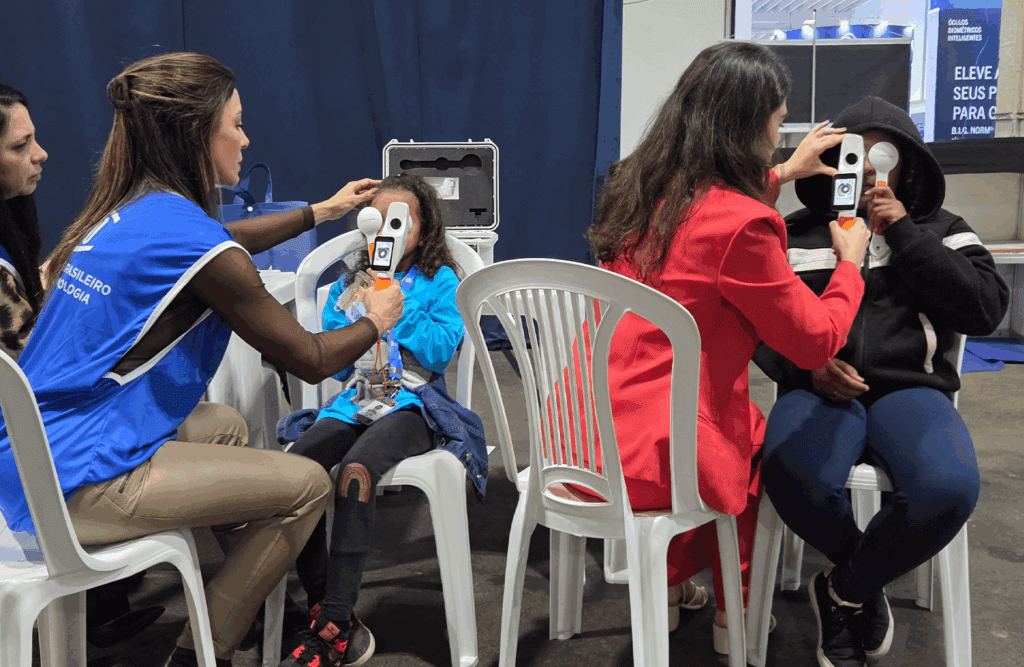
Know exactly why — not just whether.
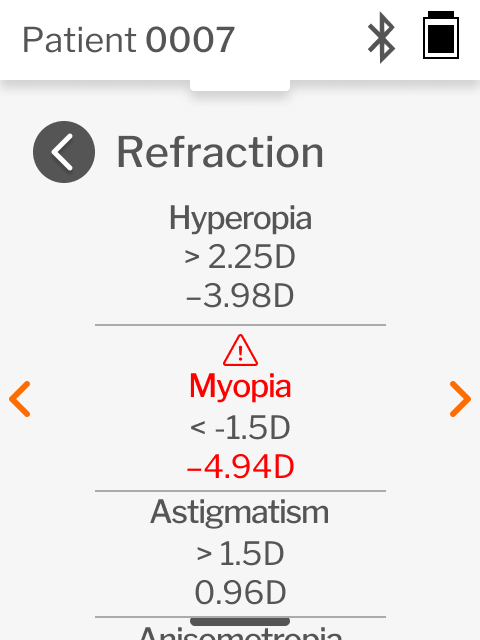
Most screeners return a binary pass/refer with no breakdown of what drove the result. QuickSee Free tells you which parameters triggered the flag, the measured values, and the thresholds applied. That’s the difference between a referral and actionable clinical data.
With an AUC of 0.95 for myopia detection (Bui et al., 2025) — the fastest-growing childhood vision condition — QuickSee Free’s wavefront technology delivers both pediatric screening accuracy and the clinical transparency providers need to act confidently.
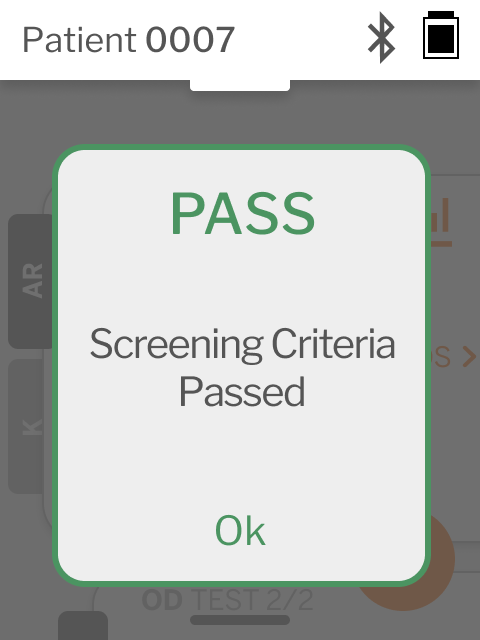
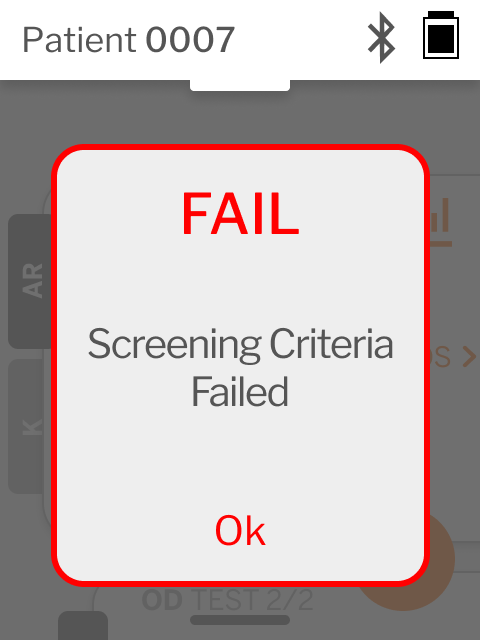
Fast, accurate pass / fail feedback
Detailed clinical data on what caused screening failures
Not just a flag. A complete refraction picture.
Other screeners tell you who needs a workup. QuickSee Free gives the receiving clinician a head start: a comprehensive optical analysis of the eye — full wavefront-based refractive data, captured at the moment of screening. No starting from scratch. That’s what wavefront aberrometry — the same technology behind LASIK surgery planning — makes possible in a handheld device.
Clinical determinations remain with the eye care professional. QuickSee Free’s role is to make every referral better informed.

Built for the populations that need it most.
Schools, community outreach, mobile programs
Operates in any lighting — no dim room required, no calibration needed. The only device in its class that works reliably across the full range of real-world outreach environments.
Elder care and nursing home rounds
Full refraction and a triage result in a single step. When a resident is flagged, their complete refractive data is already captured — no second measurement needed, no re-examination in a difficult setting.
Mixed-age and general populations
Pediatric and adult-population guideline frameworks included. Screen children and adults in the same session without switching devices.
Diverse populations
Wavefront aberrometry is unaffected by iris pigmentation — a documented accuracy concern with photoscreeners in diverse communities.
Autorefraction you can trust.
Peer-reviewed clinical studies across adult and pediatric populations—including young children—demonstrate that objective refraction measurements obtained with QuickSee technology show strong agreement with subjective refraction and accuracy comparable to benchmark desktop autorefractors.
±0.25D
Excellent agreement: 70–75% of adult patients
Most precise threshold in clinical research
±0.5D
Good agreement: 80–90% of adult patients
Standard clinical threshold in
literature
Within ±0.50 D for astigmatic components
Precision on the hardest component to measure
Peer-reviewed results published in




How QuickSee Free compares to other screeners
| Feature | QuickSee Free | Welch Allyn® Spot™ | plusoptiX® S12 |
|---|---|---|---|
| Refractive data at point of screening | Wavefront-based refraction, validated against subjective refraction and shown to produce well-tolerated spectacle prescriptions1,2 | Evaluates refraction, pupil size and gaze to help assess whether the subject should be referred to an eye care specialist for further evaluation3 | Measures sphere, cylinder and axis; manufacturer states the values must not be used directly to prescribe glasses or contact lenses4 |
| Wavefront aberrometry | Yes — wavefront aberrometry with manifest refraction predicted from dynamic retinal image-quality analysis5,6 | No — Eccentric photorefraction (photoretinoscopy)3 | No — manufacturer's measurement technology is binocular infrared photoretinoscopy7 |
| Performance across ocular pigmentation | Validated in field studies in The Gambia, Amazonas, South Africa and rural India1,8,9,10 | Myopia sensitivity varied with ocular pigmentation: 0.78 lighter, 0.52 medium, 0.49 darker (n = 1,040); the pattern was reversed for hyperopia11 | No pigmentation-stratified analysis identified in the literature reviewed12,13,14 |
| Adult / mixed-age published validation | Yes — adult cohorts in a randomized crossover trial, a 708-participant field study and a street-medicine study1,2,15 | Indicated for use on subjects six months of age through adults3; published validation identified is predominantly paediatric, benchmarked against paediatric AAPOS amblyopia risk-factor thresholds11,12,13 | Intended use is framed around paediatric preventative eye care; measurement values are compared with age-dependent referral criteria4. Published validation identified is paediatric13,14 |
| Ambient lighting requirements | Works in any ambient lighting condition, indoors or outdoors | Dimming room lights is recommended before screening3 | Manufacturer recommends closing curtains, blinds and shutters to block sunlight and turning off heat-producing light sources; the room need not be dark, and cold light sources do not affect measurements4 |
Learn what QuickSee Free can do for your program
If you would like to see QuickSee Free in use, the next step is to schedule a demo or an on-site trial.
An on-site evaluation allows your team to assess refraction accuracy, workflow fit, and usability in your own care environment, with your patient population and staffing model.
QuickSee Free enables clinicians to perform refraction using objective measurements. Clinical judgment and comprehensive eye examinations remain the responsibility of the licensed provider.
|
Note on intended purpose. QuickSee Free is a wavefront autorefractor
intended for measurement of refractive error. Welch Allyn Spot and plusoptiX S12 are vision screeners intended to
identify individuals requiring referral for further evaluation; neither manufacturer intends its measurement
values to be used directly for prescribing. The devices are not equivalent in intended purpose and this
comparison is not a claim of substitutability. All statements attributed to competitor products are descriptive
summaries directly supported by those manufacturers' current published documentation as cited, not verbatim
quotations. “No published
validation identified” and “no analysis identified” refer to the peer-reviewed literature
reviewed as of August 2026 and are not statements about device capability. References. 1. Durr NJ, Dave SR, Lim D, et al. Quality of eyeglass prescriptions from a low-cost wavefront autorefractor evaluated in rural India: results of a 708-participant field study. BMJ Open Ophthalmol. 2019;4:e000225. doi:10.1136/bmjophth-2018-000225. https://doi.org/10.1136/bmjophth-2018-000225 2. Joseph S, Varadaraj V, Dave SR, et al. Investigation of the accuracy of a low-cost, portable autorefractor to provide well-tolerated eyeglass prescriptions: a randomized crossover trial. Ophthalmology. 2021. doi:10.1016/j.ophtha.2021.05.030. https://doi.org/10.1016/j.ophtha.2021.05.030 3. Welch Allyn. Spot® Vision Screener Model VS100 Directions for Use (DIR 80024271, software v3.1.XX, rev. 2018-12), “Intended use” (p. 1) and “Screening Environment” (p. 23). https://www.hillrom.com/content/dam/hillrom-aem/us/en/sap-documents/LIT/80024/80024271LITPDF.pdf 4. Plusoptix GmbH. plusoptiX S12C / S12R Mobile Vision Screener User Manual, §1 “Intended use and responsibility of the operator” (p. 4) and §8 “Preparing the measurement area” (p. 16). https://www.plusoptixinc.com/fileadmin/Downloads/Products/Vision_Screeners/S12/Plusoptix_S12C_S12R_User-manual-PAD_us.pdf 5. Gil A, Hernández CS, Nam AS, et al. Predicting subjective refraction with dynamic retinal image quality analysis. Sci Rep. 2022;12:3714. doi:10.1038/s41598-022-07786-0. https://doi.org/10.1038/s41598-022-07786-0 6. Hernández CS, Gil A, Casares I, et al. Prediction of manifest refraction using machine learning ensemble models on wavefront aberrometry data. J Optom. 2022. doi:10.1016/j.optom.2022.03.001. https://doi.org/10.1016/j.optom.2022.03.001 7. Plusoptix GmbH. plusoptiX S16 / S12C / S12R Vision Screener product brochure (ed. 09/12/17), “Measurement Technology” specification table (p. 9), lists the technology as binocular infrared photo retinoscopy with unique 54 LED illumination. https://carletonltd.com/admin/sites/default/files/pdfs/plusoptix-S16-S12C-S12R%20Vision%20Screener%20brochure-high%20compression.pdf 8. Loayza A, Lewis A, Chamberlin S, et al. Evaluation of the PlenOptika QuickSee Free portable autorefractor in schools in The Gambia. J Pediatr Ophthalmol Strabismus. 2024. doi:10.3928/01913913-20241105-03. https://doi.org/10.3928/01913913-20241105-03 9. Chaves Filho C, Dantas D, Neto F, et al. Evaluation of refraction outcomes from the QuickSee wavefront autorefractor versus subjective clinical refractometry in children with restricted access to eye care in Amazonas, Brazil. Cureus. 2024;16(9):e69945. doi:10.7759/cureus.69945. https://doi.org/10.7759/cureus.69945 10. Nyathela X, Nirghin U, Ebrahim Khan N. Prevalence of uncorrected refractive error in low-resource high schools in the Free State, South Africa. Afr J Prim Health Care Fam Med. 2025;17(1):e1–e8. doi:10.4102/phcfm.v17i1.4967. https://doi.org/10.4102/phcfm.v17i1.4967 11. Pophal CJ, Trivedi RH, Bowsher JD, et al. Effectiveness of the Spot™ Vision Screener with variations in ocular pigments. Am J Ophthalmol. 2024;264:99–103. doi:10.1016/j.ajo.2024.03.018. PMID:38579921. https://doi.org/10.1016/j.ajo.2024.03.018 12. Forcina BD, Peterseim MM, Wilson ME, et al. Performance of the Spot Vision Screener in children younger than 3 years of age. Am J Ophthalmol. 2017;178:79–83. doi:10.1016/j.ajo.2017.03.014. PMID:28336401. https://pmc.ncbi.nlm.nih.gov/articles/PMC5797938/ 13. Crescioni M, Miller JM, Harvey EM. Accuracy of the Spot and Plusoptix photoscreeners for detection of astigmatism. J AAPOS. 2015;19(5):435–440. doi:10.1016/j.jaapos.2015.07.284. PMID:26486025. https://pmc.ncbi.nlm.nih.gov/articles/PMC4617546/ 14. Ugurbas SC, Kucuk N, Isik I, et al. Objective vision screening using PlusoptiX for children aged 3–11 years in rural Turkey. BMC Ophthalmol. 2019;19:73. doi:10.1186/s12886-019-1080-7. https://bmcophthalmol.biomedcentral.com/articles/10.1186/s12886-019-1080-7 15. Samanta A, Shetty A, Nelson PC, et al. The Street Medicine Auto-Refraction Technology study: a model for screening and treating refractive error in persons experiencing homelessness. Am J Ophthalmol. 2024;270:183–191. doi:10.1016/j.ajo.2024.07.023. https://doi.org/10.1016/j.ajo.2024.07.023 Welch Allyn® and Spot™ are trademarks of Welch Allyn, Inc. plusoptiX® is a registered trademark of Plusoptix GmbH. Used for identification only; no affiliation or endorsement implied. |