Your standards have risen. Your tools’ standards should too.
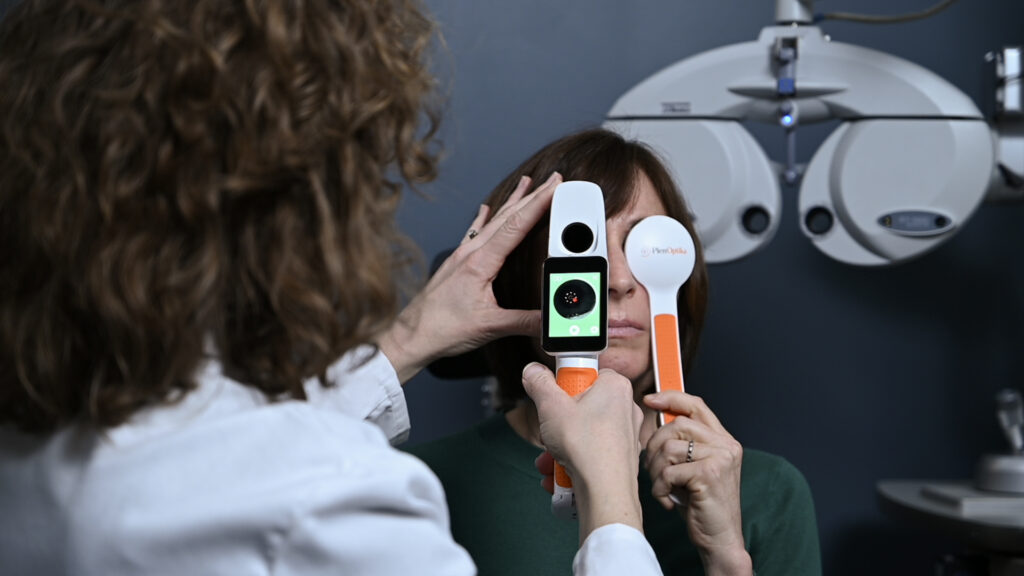
Refraction has long been treated as a box to check — fast, functional, done. But the data you collect in those few seconds can do far more than populate a prescription. The right device surfaces higher-order aberrations, flags corneal irregularities, screens against clinical guidelines, and puts actionable information in your hands before the patient leaves the room.
Once you see what’s possible, the tools you’ve been working with don’t look dated — they look inadequate.
Four dimensions that matter most when choosing an autorefractor
ACCURACY
Measurements you can act on
A result is only as useful as its agreement with the gold standard. QuickSee Free Pro’s wavefront aberrometry and open-view design reduce accommodation artifact, producing refraction data that closely matches subjective refraction — without cycloplegia.
CLINICAL DATA
Beyond sphere, cylinder, and axis
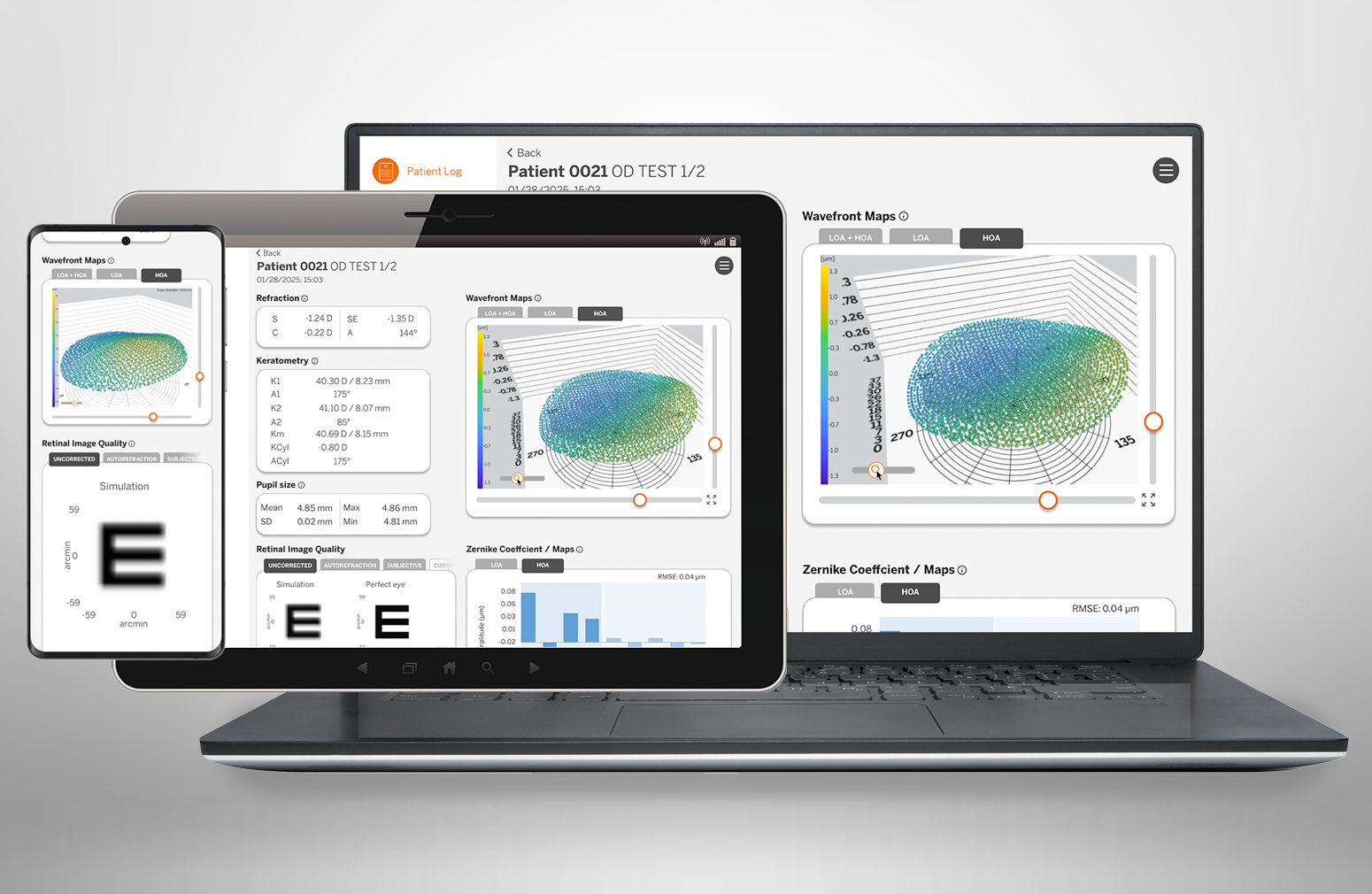
A refraction is a starting point. QuickSee Free Pro adds keratometry, higher-order aberrations, Zernike coefficients, wavefront maps, and spot diagrams — enabling triage for corneal conditions and media opacities that other handhelds cannot detect.
USABILITY
Works anywhere, for anyone
Calibration-free. Lighting-independent. Under 750 g. Six-hour battery. Care comes to the patient — not the other way around. Portability isn’t a convenience; it’s what makes vision care accessible to people who can’t easily come to it.
ANALYTICS
From data to decisions
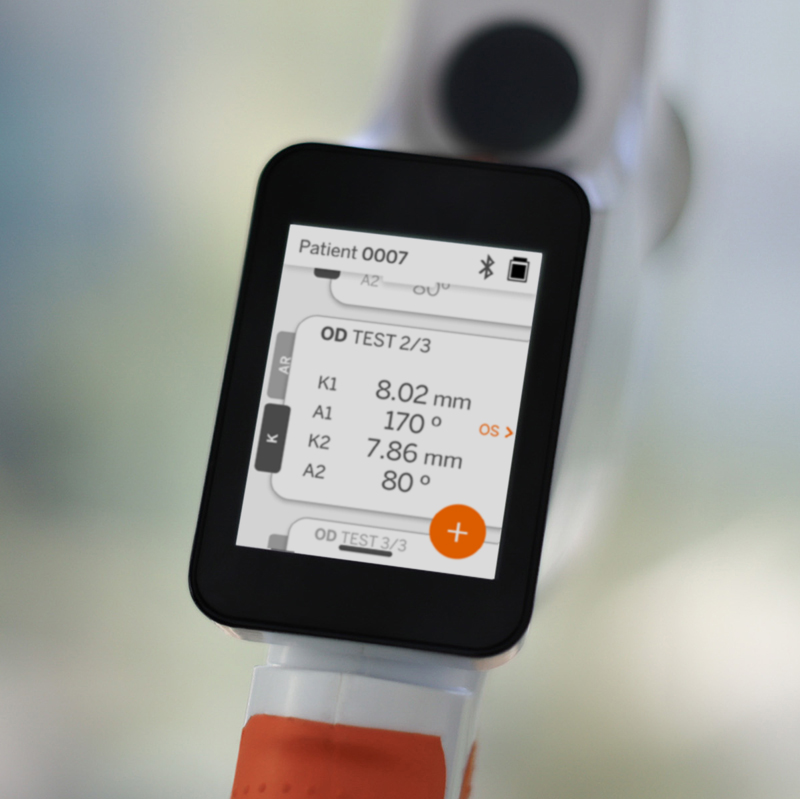
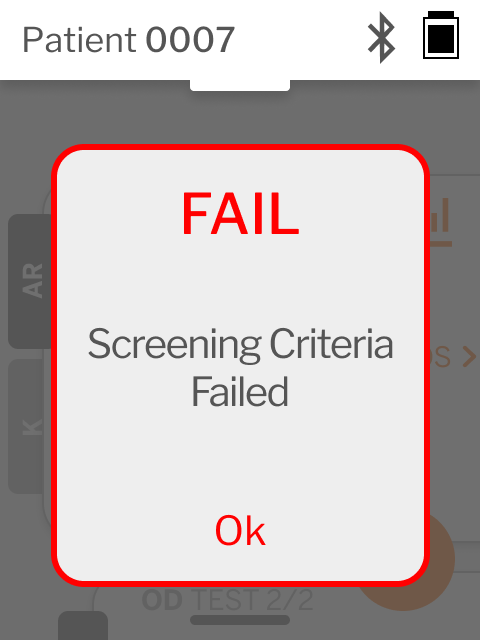
Measurements alone don’t drive referrals — structured interpretation does. QuickSee is the only handheld autorefractor with built-in screening mode, guideline-based pass/refer logic, a companion analytics app, and patient-ready printed reports.
QuickSee Free Pro vs:
Comparison 1 of 3
QuickSee Free Pro vs. other handheld autorefractor/keratometers
Not all handhelds are equal. QuickSee Free Pro is lighter, more accurate, and delivers clinical data no competitor provides.
| QuickSee Free Pro |
Nidek ™ HandyRef-K2 |
Visionix® Retinomax™ K-Plus 53 |
|
|---|---|---|---|
| Under 800 gLighter means less fatigue in high-volume screening | ✓ | ✓ | ✗ |
| Within ±0.5 D of subjective refraction in 90% of patients1Open-view wavefront aberrometry vs. close-view infrared—a fundamental technology difference | ✓ | ✗ | ✗ |
| Validated for use in children without cycloplegiaOpen-view design; competitors use close-view optics | ✓ | ✗ | ✗ |
| Simultaneous AR + keratometryOne measurement, no repositioning | ✓ | ✓ | ✓ |
| Higher-order aberration & wavefront dataZernike coefficients, wavefront maps, spot diagrams | ✓ | ✗ | ✗ |
| Built-in pass/refer screening modeAAPOS 2021, Modified Orinda, or custom guidelines | ✓ | ✗ | ✗ |
| Companion app for data managementAndroid, Windows, macOS; DICOM; PDF/CSV; retroactive guideline analysis | ✓ | ✗ | ✗ |
| Patient education reportPrintable results patients can take home | ✓ | ✗ | ✗ |
Comparison 2 of 3
QuickSee Free Pro vs. Welch Allyn® Spot™
The Spot tells you whom to refer. QuickSee Free Pro tells you why — and gives you the data to act on it.
| QuickSee Free Pro |
Welch Allyn® Spot™ |
|
|---|---|---|
| Built-in pass/refer screening modeAAPOS 2021, Modified Orinda, or custom guidelines | ✓ | ✓ |
| Provides prescription-quality refraction outputSphere, cylinder, axis — usable as starting point for Rx | ✓ | ✗ |
| Within ±0.5 D of subjective refraction in 90% of patients1Spot provides binary pass/refer only — no refractive accuracy benchmark | ✓ | ✗ |
| Detects hyperopia reliably4Spot sensitivity for hyperopia in school-age children: ~27% | ✓ | ✗ |
| Provides keratometryCorneal curvature measurements for contact lens fitting and triage | ✓ | ✗ |
| Higher-order aberration & wavefront dataFlags irregular corneas, media opacity, keratoconus risk | ✓ | ✗ |
| Companion app for data managementAndroid, Windows, macOS; DICOM; PDF/CSV; retroactive guideline analysis | ✓ | ✗ |
| Patient education reportPrintable results patients can take home | ✓ | ✗ |
| Detects strabismusBinocular simultaneous capture required | ✗ | ✓ |
| Validated from 6 months of ageQuickSee Free Pro validated from age 3+ | ✗ | ✓ |
Comparison 3 of 3
QuickSee Free Pro vs. desktop autorefractor
As accurate as the instruments it replaces — and able to go where they never could.
| QuickSee Free Pro |
Desktop Autorefractor |
|
|---|---|---|
| Within ±0.5 D of subjective refraction in 90% of patients1The real gold standard — glasses patients can't tell from a full workup5 | ✓ | ✓ |
| Works outside a dedicated exam roomClassrooms, care homes, mobile clinics, home visits | ✓ | ✗ |
| Accessible to patients with mobility or cognitive challengesNo chin rest, no forced stillness, no dark room required | ✓ | ✗ |
| Validated for use in children without cycloplegiaOpen-view design eliminates accommodation artifact | ✓ | ✗ |
| Higher-order aberration & wavefront dataZernike coefficients, wavefront maps, spot diagrams | ✓ | ✗ |
| Companion app for data managementAndroid, Windows, macOS; DICOM; PDF/CSV export | ✓ | ✗ |
| Patient education reportPrintable results patients can take home | ✓ | ✗ |
¹ Accuracy vs. subjective refraction (75% / 90%)
Agarwal et al. (2019); Samanta et al. (2020). Peer-reviewed meta-analysis of handheld autorefractors vs. subjective refraction; QuickSee studies rated most rigorous; QuickSee found to be the most accurate handheld autorefractor.
² HandyRef head-to-head
Nidek International. Official website with product information.
³ Retinomax head-to-head
Agarwal et al. (2019). Head-to-head study in older adults in India; QuickSee vs. Retinomax vs. Netra compared against cycloplegic retinoscopy/refraction. QuickSee mean difference vs. SR: −0.05 D (SD 1.04); Retinomax: −0.41 D (SD 2.14).
⁴ Spot hyperopia sensitivity
Peterseim et al. (2025). “Evaluation of the QuickSee portable autorefractor system in a pediatric population” J AAPOS. 2025 Jun;29(3):104228.
⁵ Glasses indistinguishable from full subjective workup
Joseph et al. Ophthalmology 2021; 128(11). “Investigation of the Accuracy of a Low-Cost, Portable Autorefractor to Provide Well-Tolerated Eyeglass Prescriptions: A Randomized Crossover Trial.” Of 301 completers, 50.5% preferred SR-prescribed glasses vs. 49.5% QuickSee-prescribed (p = 0.86); no statistically significant difference.
Ready to see what your current device is missing?
QuickSee Free Pro helps you reduce guesswork, support more confident recommendations, and bring strong objective measurement into the workflows where you need it most.
If you’re ready for a 10-day trial in your practice right now, click the button immediately below. Or if you’d like to learn more and get an online demo first, tell us more about yourself below. One of our associates will reach out to you by telephone or email shortly to answer your questions and arrange a next step.
Want a trial device right away?
If you would like to try QuickSee Free or QuickSee Free Pro in your practice, please visit our Trial Program page to act quickly.