Accurate binocular autorefraction
anywhere

QuickSee is discontinued. Please inquire for more information. 

QuickSee helps you perform clinical-quality mobile eye care for anyone in the world, regardless of their access to vision care clinics.​

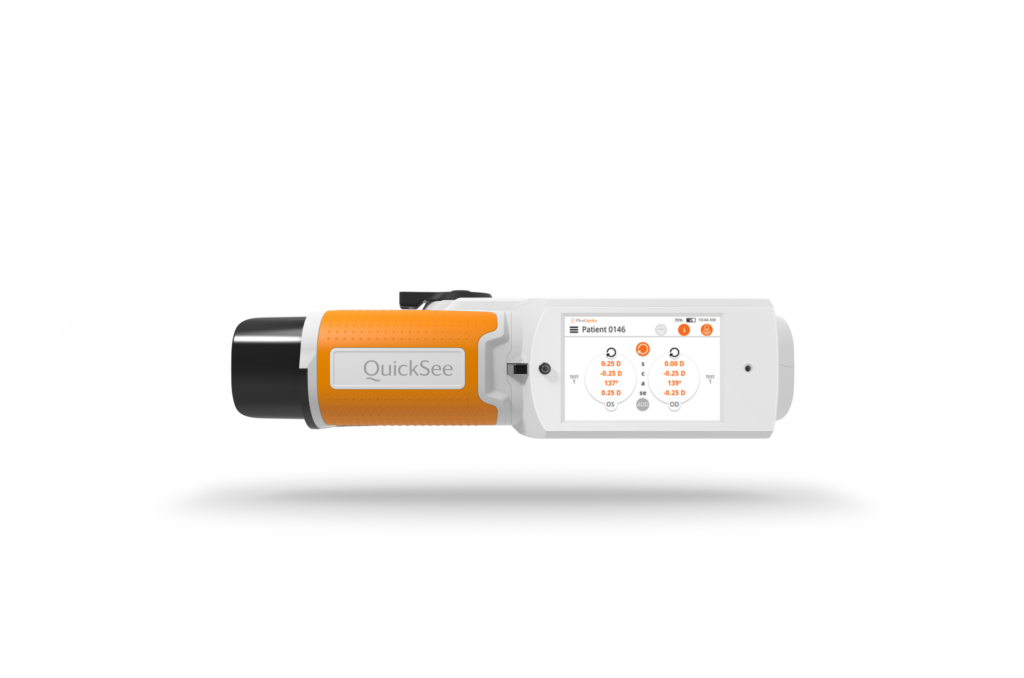
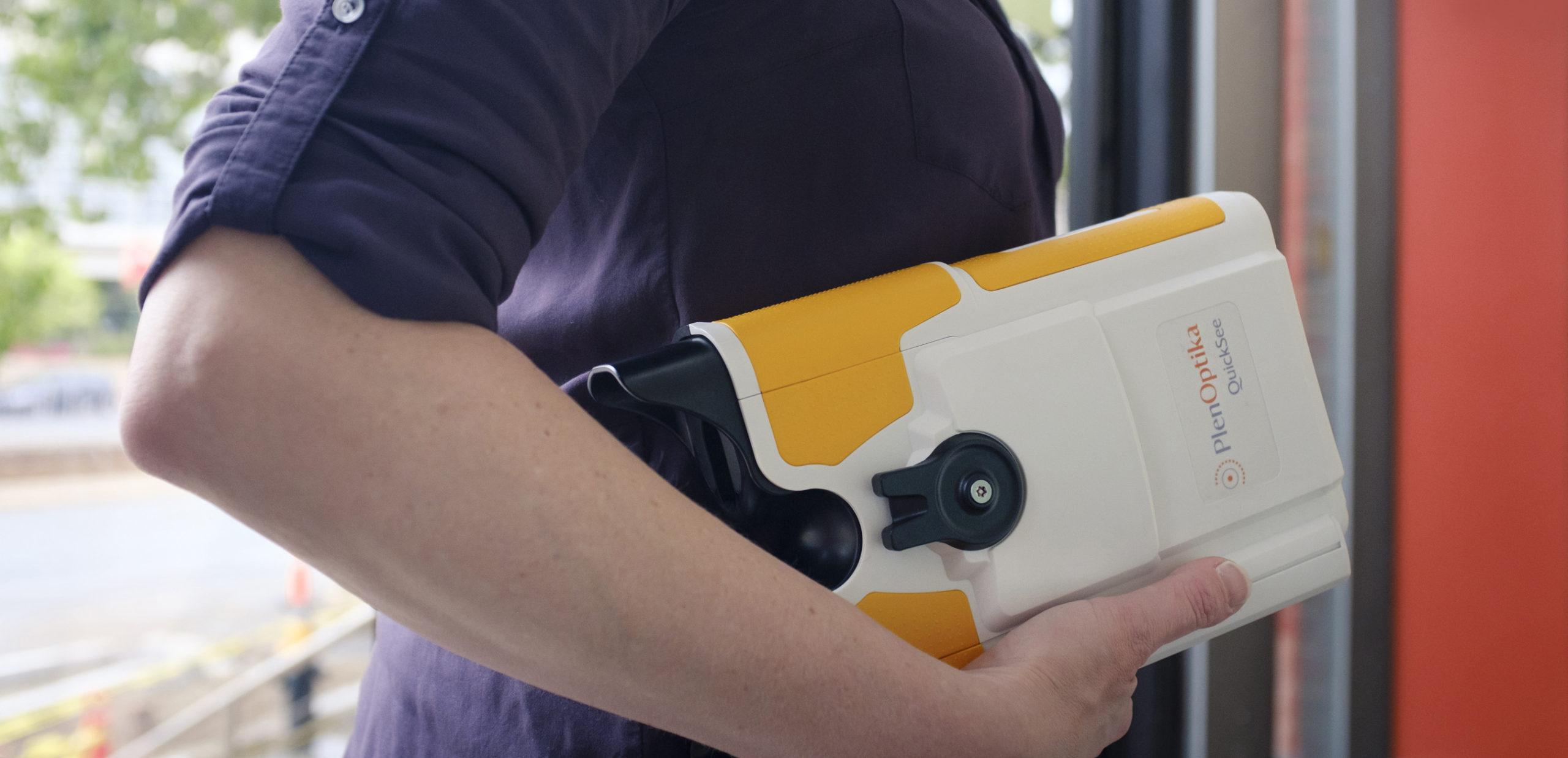
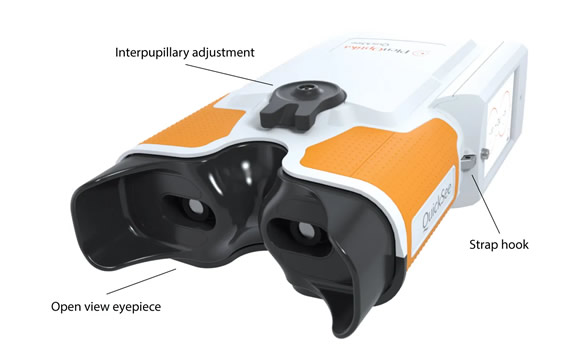
Because QuickSee puts clinical quality autorefraction in a handheld package, you can deliver high quality care to patients anywhere. QuickSee can replace your retinoscope, desktop autorefractor, or pediatric vision screener.

Discontinued; inquire for details

QuickSee benefits in
mobile care​

✓ Clinical-quality binocular measurements in 10 seconds

✓ Can be used indoors and outdoors

✓ Not sensitive to ambient light

✓ Durable and calibration free

✓ Operates in humid and dusty environments

✓ Includes a hardened carrying case

QuickSee applications​

✓ NGO/mission-driven vision programs in developing countries

✓ Community health initiatives

✓ Flexible clinical / optometric shop practice

✓ Private home visits

✓ Nursing and retirement home visits

✓ School and workplace vision outreach

Other benefits

ADA Compliant

Accessible for patients with mobility issues and/or physical challenges

Binocular measurements in 10 seconds​

Accelerates subjective refraction with a more accurate starting point
Enables high throughput autorefraction

Handheld

Easy to use anywhere
Patient friendly

Strong agreement with subjective refraction​

<= 0.25 D: 70-75% of patients

<= 0.5 D: 80-90% of patients (see publications)

Field durable

Calibration free
Operates in humid and dusty environments
Can be used indoors and outdoors, in most light settings
Includes hardened carrying case
Up to 8 hours continuous use on battery, operates while tethered for charging

How QuickSee works​

KEY FEATURES

Binocular and open view

Reduces patient accommodation for more reliable measurements

Wavefront aberrometry

Provides the most comprehensive method to measure ocular aberrations
and refractive errors

Dynamic measurements

Produces results with high confidence

QuickSee’s combination of the open view binocular design, wavefront aberrometry, and dynamic measurements produces clinically accurate autorefraction measurements, in a durable handheld format suitable for use in clinics and in the field.

The patented PlenOptika Wavefront Refraction Engine™ performs continuous data analysis to precisely determine low-order refractive errors, making QuickSee as accurate as the high-end clinical desktop autorefractors and demonstrating excellent agreement with subjective refraction.

The technology inside QuickSee has been clinically-evaluated in five IRB-based studies and documented in seven peer-reviewed publications and conference abstracts. QuickSee has FDA Class I 510(k) exempt medical device registration.

QuickSee delivers binocular measurements that agree strongly with subjective refraction in 10 seconds

QuickSee technology and applications in mobile care​

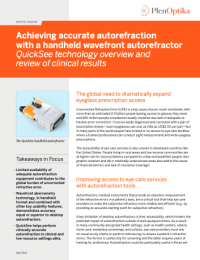
These PDFs explain how QuickSee technology achieves accurate autorefraction anywhere, and shares results from seven peer-reviewed clinical study reports.

Technology white paper​

Mobile care white paper​

"With so many patients to see in a short time, we had to go very fast. QuickSee was a tremendous asset."

Alan Glazier, OD
Shady Grove Eye and Vision Care (Rockville, MD) and ODs on Facebook community leader, who used QuickSee in a mission to hurricane-devastated islands

"A significant bottleneck in giving corrective glasses to the over a billion people who need them is the inability to provide an accurate prescription. There just aren’t enough skilled people available to do this nor the right technology that is accurate, easy to learn, affordable and portable. This indeed is the urgent innovation need of the day to help people see better."

Thulasiraj Ravilla
Director-Operations, Aravind Eye Care System  

"It was for me love at first sight on the equipment that I wanted, and we got it. What the ideal thing of QuickSee is that it's very accurate… QuickSee is the best solution for this that I’ve seen, and the most affordable one."

Bijan Azami
Founder, Two Billion Eyes

Clinical Performance Specifications​

Intended patient population5–85 years old
Accuracy (agreement with
subjective refraction)
<= 0.25 D: 60-70% of patients
<= 0.5 D: 80-90% of patients (see publications)
Cylindrical range-6D to +6D, increments of 0.01D, 0.125D, 0.25D
Axial range0–180º, increments of 1, 5, 10 degrees
Spherical Range-10D to +10D, increments of 0.01D, 0.125D, 0.25D
Interpupillary distance range47–78mm continuous
Accommodation controlBinocular open view
Pupil size2–8mm
Cycloplegia requirementNone
Amblyopia or strabismusMay require monocular measurement
Contact lens wearersOver-refraction compatible
Dilation requirementNone
Illumination requirementsWorks in any illumination
Furniture requirementsNone
MaterialsThis product is latex-free
Storage/transportTravel hardshell case included

Technical Specifications

Technology
 
Wavefront aberrometry
Measurement mode(s)Binocular and monocular
Measurement time10 seconds
CalibrationFactory calibrated, no field calibration needed
Battery life6–8 hours of operation; 6 hours charge time
(10 hours for initial charge)
CommunicationsBluetooth via QuickSee Companion App
and Bluetooth printer
Measurement capacity10,000 measurements
RegulatoryClass I
Class IIa Product CE
Laser safetyClass 1, enclosed
Electrical safetyCompliant with IEC 60601-1(2005, 3.1 ed.)
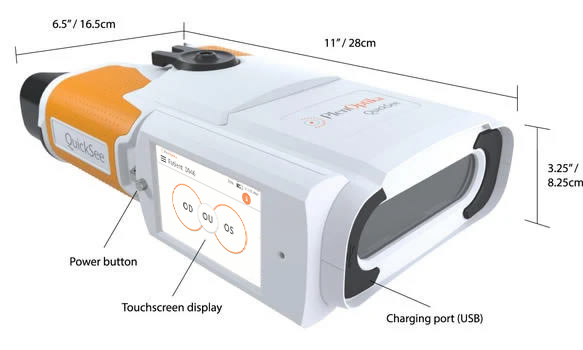
Weight3.14lbs / 1.42kg (without case)
6.95lbs / 3.15kg (with case)
Dimensions6.5 x 11 x 3.25 '' / 16.5 x 28 x 8.25 cm
Warranty1 year warranty

Simple, handheld, and rugged design​

Easy to learn, easy to use, and patient friendly

How was it validated?

What patients does it work on?
How are data handled?